How do I get my site listed on Google? First steps
You have just built your website, you are thrilled, it looks great… but it doesn't seem to appear on Google? Find out how to get your site listed.
As a hosting provider, we regularly receive requests like this one:
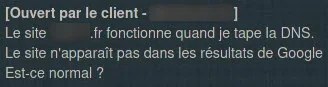
This is a matter of search engine listing, known in the jargon as "SEO" (search engine optimisation).
Today, we will help you take the plunge into the wide world of the internet and get your site listed.
1) Why isn't my site listed?
As with any new website, you are excited and want to shout about your site to the whole world. You may even imagine that the internet has just been waiting for you and that millions of clicks will roll in straight away. Unfortunately, the internet doesn't work in quite such an idyllic way.
Let's start from a simple fact: in 2021 there are nearly 2 billion websites.
From this we can conclude that:
- It is not necessarily easy or automatic for search engines to find and list new sites.
- Your site will be in competition with many other sites.
If your site is new, you will therefore need to find a way to make search engines aware of it and come up with strategies to give it visibility.
2) How do I get search engines to discover and list my site?
Although the exact workings of ranking algorithms are kept secret, we do know their main principles.
Through existing sites
Google, like other search engines, relies first and foremost on existing sites to find links to new ones.
So if your site is mentioned on your Facebook, Instagram or Twitter page, on blogs, on other websites or on forums, search engines are far more likely to become aware of it and list it.
The number of mentions
The number of times your site is mentioned on other sites will weigh heavily on your site's position in search engines. If only one site talks about you, you are less likely to rank well than if ten sites talk about you. This factor still seems very important today, so make sure you get yourself talked about!
Google Search Console
Google offers a tool, Search Console, that lets you verify ownership of your site: https://search.google.com/search-console
With Search Console, you can actively tell Google that your site exists and track its indexing, your position in searches and various statistics that are useful for growing your online presence.
A few extra tips for better SEO
To rank well, your site must contain unique, appealing keywords.
If your site uses HTTPS, search engines will give it more prominence. Take advantage of this, and ask HaiSoft support for advice if you need it.
If similar sites already exist, you need to find a way to stand out and choose your keywords carefully.
The titles of the site, its pages and its posts must also be chosen with care.
Your URLs should be crafted so that they contain no unnecessary information and reflect the article being read.
Your site's menus can help your visitors, and also help search engines classify pages and results.
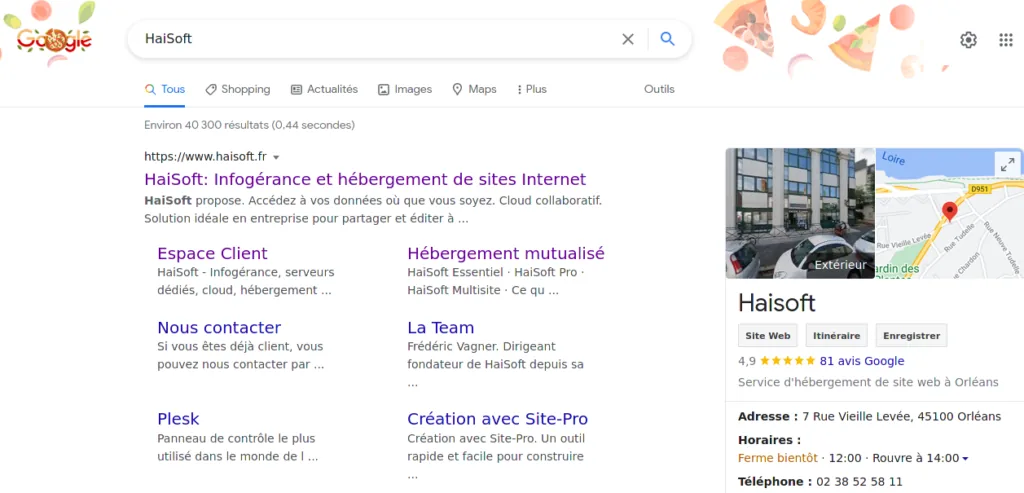
If you have a physical location, list your premises and their details, linking them to your website's URL. This will be added to and highlighted in search results.
Various "META" tags in your site's code can help search engines categorise and index your site. Most modern CMSs such as WordPress handle this natively; however, some fields, such as image descriptions, have to be filled in manually.
An XML sitemap can be added to your site to help search engines find all its pages.
Your content must be original, in other words not copied and pasted from an existing site.
Fresh content matters: write articles regularly and keep your pages up to date. A "dead" site is likely to be less attractive to visitors, and therefore to search engines, which measure visitor interest and rank results according to visitor behaviour.
Visit HaiSoft today to create your website!