National extension, .eu or .com: what the figures really say about choosing an extension
"I need a .com." That is often the first thing people say when launching a website. Yet in Europe, that is not what most businesses do: they choose their own country's extension first. Here is a quick overview, with figures to back it up.
.com dominates… mainly in North America
Of the roughly 400 million domain names registered worldwide, .com accounts for about 41%, according to Verisign. Country-code extensions (.fr, .de, .uk, .eu…) make up a little over a third.
But it all depends on where you look. According to Afnic, country-code extensions account for 60% of domain names in Europe, compared with only 4% in North America, where .com reigns with 67% of the market. The "default .com" reflex is therefore first and foremost an American one.
In Europe, the national extension is the first choice
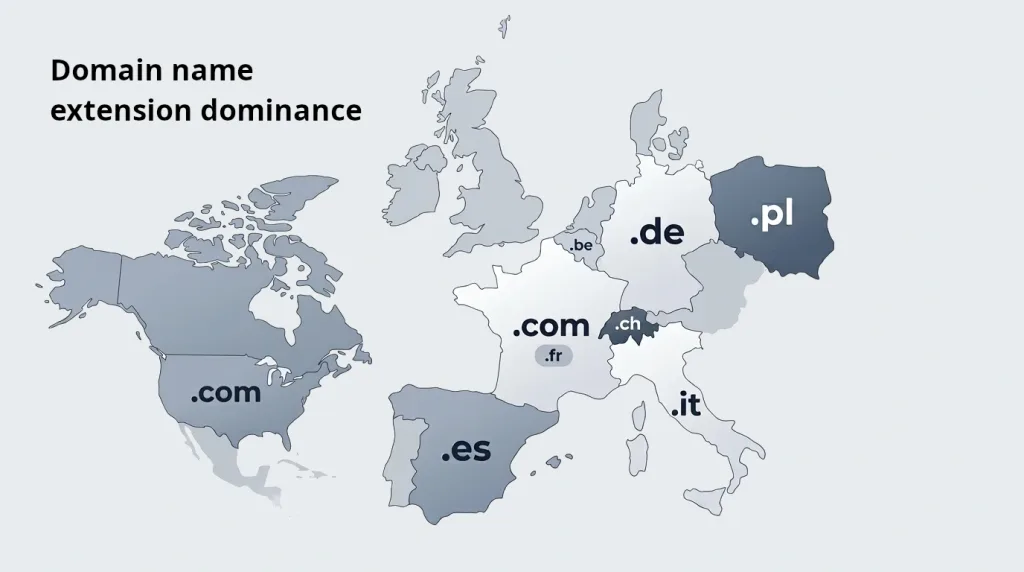
In most European countries, the national extension accounts for more than half of the domain names held locally:
Share of the national extension among domain names held in each country. Data from national registries; the year varies by country.
A few striking figures:
- Germany: with more than 18 million names, .de is the largest country-code extension in Europe. Three out of five names held in Germany are .de.
- Belgium: .be is more than three times the size of .com (56% versus 17%).
- Italy: .it is ten points ahead of .com (47% versus 37%).
- Netherlands: around 6 million .nl names for 18 million inhabitants, or almost one name for every three people.
What about France?
France is a special case: .com (44%) is still slightly ahead of .fr (40%). But the momentum is clearly in favour of .fr:
- 853,000 new .fr names were created in 2025, an all-time record according to Afnic.
- .fr passed the 4.5 million names mark in September 2026, after gaining 200,000 names in just ten months.
- Its market share has grown by almost 5 points since 2015, while .com stagnated.
- Among small and medium-sized businesses, it is already the clear favourite: 62% choose .fr as their first extension, versus 33% for .com.
.eu, the European asset
.eu, which celebrated its 20th anniversary in 2026, has nearly 3.8 million names and a renewal rate of 81%, according to EURid. It accounts for 7% of names in Belgium and 4% in both Germany and Italy. For a business selling in several EU countries, it is a simple way to show a European identity, alongside its national extension.
And city extensions?
Extensions such as .paris, .berlin or .london have existed since 2014, but they remain niche: around 19,000 names for .paris, 35,000 for .london and just over 100,000 for .tokyo, the largest of them. The ones that do well rely on a strong identity, such as the Breton .bzh, which gains around 1,000 names a year.
Key takeaways
- In Europe, the national extension is the majority choice: it inspires trust and clearly signals your market.
- .fr is growing fast, especially among small and medium-sized businesses.
- .com remains useful for international ambitions, and .eu for a presence in several EU countries.
- In any case, registering the main variants of your name (your national extension, .com, .eu) protects your brand against typosquatting and impersonation.
At HaiSoft, we register and manage your domain names in .eu, .com, .co.uk and many other extensions, with hosting we operate ourselves in Europe. Need advice on choosing the right extensions? Contact us.
Main sources: Verisign (Domain Name Industry Brief, Q2 2026), Afnic (2025 .fr report and 2025 global observatory), EURid, and the national registries (DENIC, DNS Belgium, Registro .it, SIDN, SWITCH, NASK, Red.es).