Domain name extensions

We all know the .com, .fr and .org extensions, but did you know there are hundreds of them? So how do you choose?
What is a domain name extension?
Domain name extensions, also known as top-level domains, are simply what their name suggests: the extension, i.e. the final part of a domain name, whatever comes after the last dot.
Here are a few examples:
- For "wikipedia.org", the extension is ".org"
- For "blog.haisoft.fr", the extension is ".fr", while "blog." is a subdomain of the domain "haisoft.fr"
Where do these extensions come from?
Each domain name extension is managed by an independent authority. Registrars such as HaiSoft act as the link between those wishing to register a domain and these authorities. The launch of new extensions is fairly strictly regulated, although new extensions are being opened up more and more often, giving rise to extensions of every kind, such as ".paris", ".shop", ".photo" or even ".ninja". Anyone prepared to invest (sometimes quite heavily) can therefore apply to create their own domain extension, which they will then regulate.
Every domain name extension has an owner: an authority that regulates it and sets the rules that apply to it. These authorities are responsible, on the one hand, for protecting domain name registrations on behalf of their holders and, on the other, for making these domains reachable on the web (by linking them to what are known as the "master DNS" servers).
Among the historical extensions:
- For .fr domains, the authority is AFNIC.
- For .be domains, it is DNS Belgium (dns.be)
- For so-called "generic" domain names (.com, .org, .info, .biz, etc.), ICANN regulates the names.
- .eu domains are managed by EURid (pronounced "Your ID").
As individuals and companies cannot deal directly with these regulators to order a domain name, they have to go through a registrar such as HaiSoft, which has the whole infrastructure needed to manage domain registrations efficiently, as well as renewals, transfers, DNS changes and WHOIS (domain holder) changes.
How do you choose an extension?
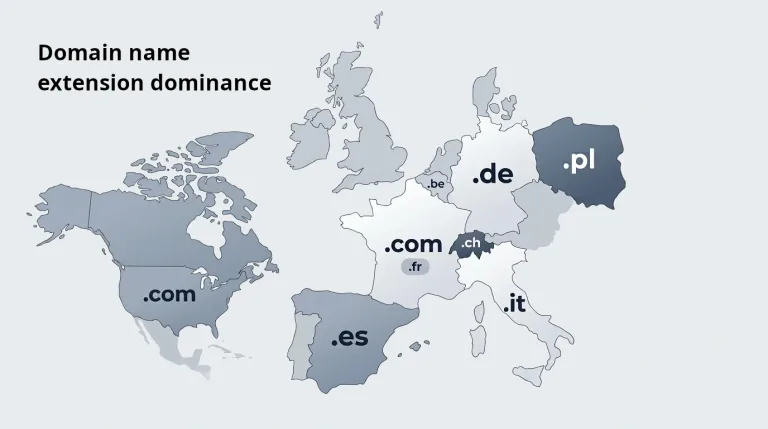
Your main domain name should be chosen according to where you are based: .fr for France, .be for Belgium, .lu for Luxembourg, .es for Spain, .co.uk for the United Kingdom. It is then worth registering other extensions for SEO, to protect your brand, or depending on your target audience or business.
Let's take an example: you run an online shop with its head office in France, but you sell in several countries around the world. In that case, it makes sense to register the following extensions:
– .fr for France
– .com for the international market
– .eu for Europe
– .es for a Spanish-language website, .de for Germany, .cn for China…
- The .tv and .info extensions for journalists, TV channels…
- The .pro extension for professionals
- The .org extension for organisations
- The .avocat.fr, .chirurgiens-dentistes.fr and .notaires.fr extensions for professionals in these specific fields (lawyers, dentists and notaries in France)
- The .tennis, .shop, .holiday, .football and .cafe extensions to stand out, to be original or to match your hobby
- The .blog extension for bloggers…
There are a great many domain name extensions, and we will try to cover them in detail in future articles. Feel free to contact our sales team for more information.